A commercial snow route is built around buildings that open Monday through Friday and fill gradually. Neither half of that describes a congregation or a campus. The hours that matter here are Sunday before eight, a weekday before the first bus, a Wednesday evening after dark and whatever a funeral or a concert puts on the calendar with three days’ notice — and the arrival is never gradual. It is two hundred people in eleven minutes.
No crew works for this site. Introductions go to independent contractors who operate under their own names, carry their own insurance and agree terms directly with the church or the school. Nothing here is a service contract.
Ask any bidder the same first question: what else is on the truck at 6 a.m. on a Sunday? A route built on offices and retail is busiest Monday to Friday between four and eight in the morning, and a Sunday service window sits in the middle of the one stretch of the week when many operators are not running at all. That is either an opportunity or a problem, depending entirely on whether the contract names the hour.
Four windows are worth writing out explicitly, each with a finish time rather than a response interval:
An office lot absorbs its occupants across two hours. A congregation arrives in one pulse, parks in every stall including the far corners nobody uses on a Tuesday, and then walks across the whole property at once. A school does the same thing three times a day in two directions.
Three consequences for the specification. Overflow parking is not optional scope — the far row is in use on exactly the mornings the lot is worst, so it cannot be the row the piles went on. The walking paths are not the paved walks; people cross where the cars are, from stall to door, over curbs and through islands, which is where treatment has to reach. And the pulse sets the deadline: a surface that is walkable at 9:40 and clear by 10:15 was clear at the wrong time.
Stacking deserves the same planning a retail lot gets, with one extra constraint: the pile cannot sit where the overflow row or the bus apron needs to be, and on most campus properties those are the only two places with room.
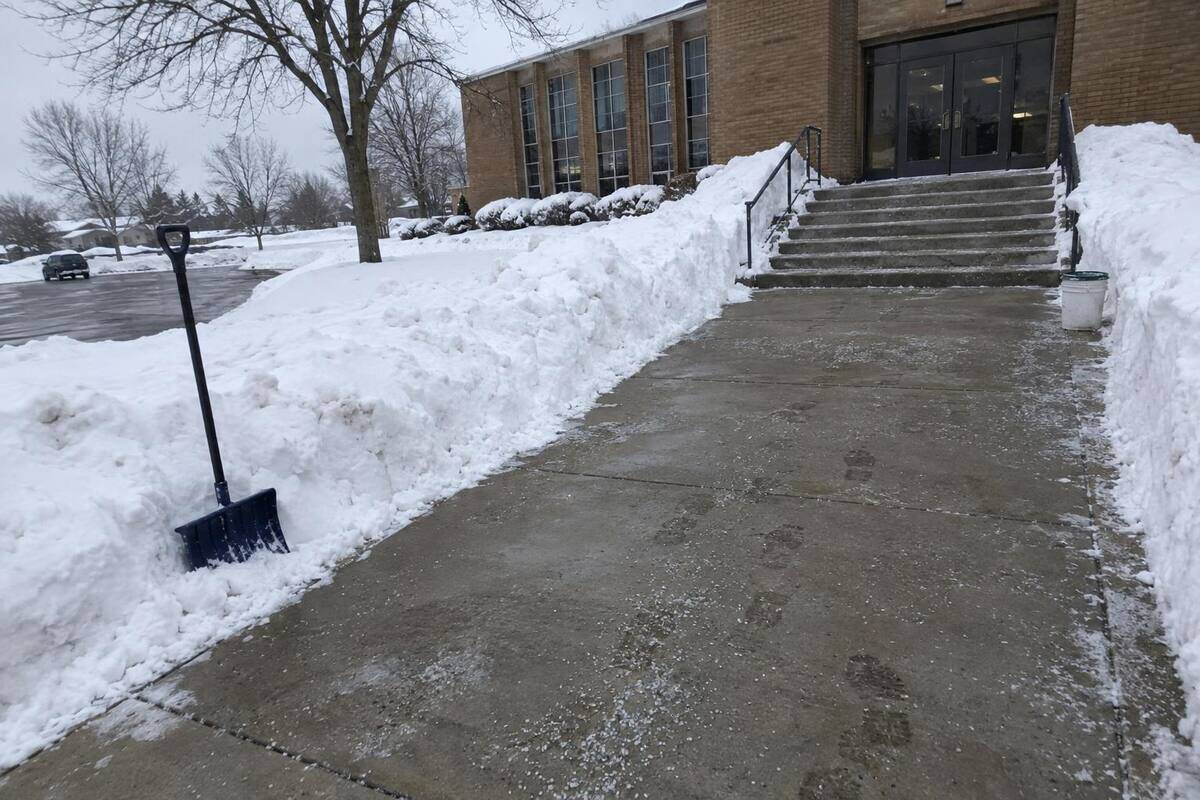
Almost every congregation in this metro has somebody who shows up with a shovel and a snowblower, and has for years. There is nothing wrong with it and no reason to stop. What changed is what happens if somebody falls anyway.
On July 28, 2023 the Michigan Supreme Court decided Kandil-Elsayed v. F & E Oil, Inc., overruling Lugo v. Ameritech Corp. A land possessor still owes invitees “a duty to exercise reasonable care to protect [them] from an unreasonable risk of harm caused by a dangerous condition” — but whether a hazard was open and obvious no longer disposes of a case at the threshold. It has moved into breach and comparative fault, which are jury questions, the “special aspects” exception is discarded, and the summary judgment in that case was reversed. The facts were a fall on an unshoveled, snow-covered walkway.
A volunteer effort, however diligent, leaves no record. A contracted pass can be made to leave one: time on site, time off, depth found, material applied, quantity used. The sensible arrangement on most properties is both — a professional pass on a documented schedule for the lot, the walks and the ice control, with volunteers handling the touch-up nobody was ever going to bill for.
This is a description of the holding and nothing further. It is not legal advice and not an assessment of any congregation’s or school’s exposure; counsel and the property’s carrier are the right sources for that.
Chloride is hard on concrete, and at least one municipality in this metro has decided the trade is not worth making. East Grand Rapids does not salt sidewalks at all. Its own explanation is direct: “Salt is not used on sidewalks because it can damage/spall the sidewalk, is harmful to the environment.” Where it does treat pedestrian surface — at school crossings — it uses concrete-safe calcium chloride instead.
For a church or school with a great deal of relatively new concrete, that is a position worth understanding before instructing anybody to salt heavily. Two things belong in the conversation with a bidder. First, what material goes on walks as against pavement, named rather than implied. Second, what happens when it gets genuinely cold: rock salt loses effectiveness below roughly 15 °F and this metro reached 19 below zero on January 24, 2026, and under that threshold the honest answer is traction material for grip rather than more chloride. Grand Rapids works the same problem from the supply side on its streets, pre-wetting salt to cut usage “by as much as 30 percent” and applying it selectively to first-attention streets, bridges, hills and curves rather than everywhere.
A contractor operating inside East Grand Rapids needs a City Clerk license under § 7.90 of that city’s code before advertising, soliciting, contracting or working there, for a period running August 1 to May 1; the city publishes who holds one. What the license requires.
Most of these buildings have public sidewalk along at least one frontage, and the duty to clear it belongs to the property whatever the municipality does with its own crews. The deadlines differ sharply from town to town:
| Municipality | What is required |
|---|---|
| Grand Rapids | 24 hours after an event ends; then notice and 48 more hours before the city clears it and bills the owner. A courtesy program covers 200+ of 922 sidewalk miles after 3 inches. |
| Grand Haven Charter Twp. | 12 hours, with a fine of not less than $50, escalating past $250 and then past $500 for repeats within six months. |
| Kentwood | Owner’s duty at 2 inches; the city plow makes one pass per event only. |
| Wyoming | City plows sidewalks at 2 inches. |
| Hudsonville | Courtesy plow, duty still the owner’s, and 60 inches kept clear around hydrants. |
Note what a courtesy plow is and is not. Where a city runs one, the pass comes at the city’s trigger and on the city’s schedule, and the property’s own deadline keeps running regardless. In a township no public crew is scheduled for a walk at all — the Kent County Road Commission states plainly that it does not clear sidewalks or non-motorized paths, and the Ottawa County Road Commission operates the same way. Every published deadline in the metro.
One line that should not appear on the invoice: Michigan’s General Sales Tax Act reaches transfers of tangible personal property and the Use Tax Act reaches a closed list of services that does not include snow removal. What the statutes provide is that the contractor pays tax on salt as its end consumer, so a sales tax line on a plowing bill is worth asking about.
List the service and program hours the property has to be ready for, the lot and overflow area, linear feet of walk including any public frontage, whether buses use the site, and whether volunteers will keep doing part of the work. That is the set a bidder needs to quote the right windows.
Call (616) 552-4542 Request Bids Grand Rapids