Gravel is not a harder version of the same job. It is a different setup on the same truck, decided before the blade ever touches the drive — and an operator who has not made that decision will move a layer of your driveway into the lawn on the first pass of the season.
The work is carried out by an independent operator with its own equipment, insurance and contract. This site makes the introduction and plows nothing.
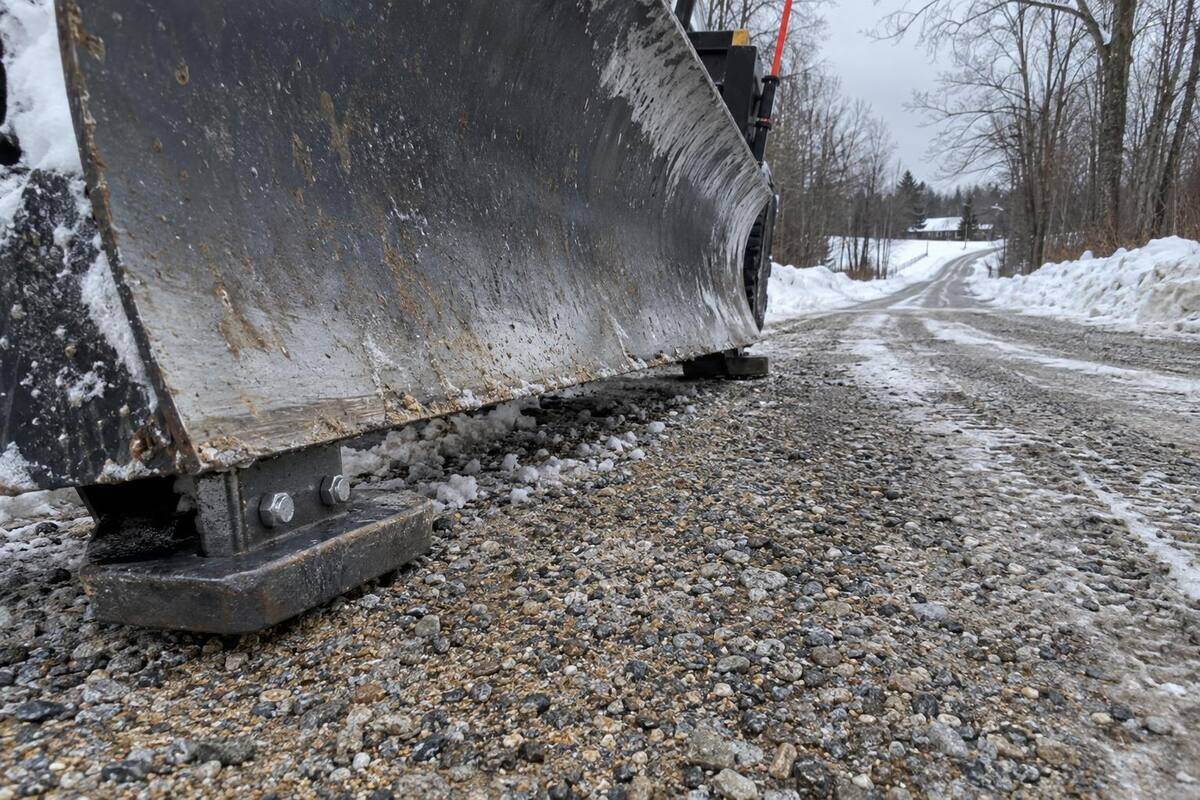
On pavement a plow is supposed to make contact. The steel cutting edge rides the surface and takes the snow down to it, which is exactly what you are paying for. On gravel that same contact is the failure. The blade cannot tell stone from snow, so it lifts both and leaves them wherever the push ends.
There are two accepted answers, and plow manufacturers publish both:
About half an inch off the surface, so it stops scraping. Simple, free, and it depends entirely on the operator holding that height across a whole drive in the dark, over ground that is not perfectly flat.
Skids that bolt to the bottom of the blade and set the height mechanically. They sit roughly 3/8 inch below the cutting edge and about half an inch above the ground, so the blade floats over the gravel rather than dragging stone forward into the windrow.
Either way, the trade-off is honest and worth stating: a gravel drive is cleared to a thin packed layer, not to a bare surface. Anyone promising bare stone after a storm is either going to scalp the drive or is describing a job they will not do twice.
The worst damage on a gravel drive almost always happens in the first few events of the season, and the reason is simple: unfrozen stone moves, frozen stone does not. Once the surface has taken a hard freeze it behaves almost like pavement under a raised blade. Before it does, every push is loose material.
The monthly normals for Gerald R. Ford International say when that window sits. November averages 7.1 inches, December 20.8, January 22.6. So the first plowable events of a normal season land in November, on ground that in a mild autumn has not locked up yet — which is the specific reason a gravel contract should be arranged before the season starts rather than after the first storm makes the problem obvious.
The same logic runs in reverse at the other end. April averages 2.0 inches here and the ground is thawing underneath it, so a late spring event on a soft gravel drive is the second-worst push of the year. Contracts in this market run to April 1, and where an operator is willing to come out after that, it is worth asking what blade height they intend to use.
A paved driveway announces its own edges. A gravel drive with four inches on it is a white rectangle with a guess at each side, and the guess is what puts stone in the grass and a blade into a culvert lip. The rate sheet published locally puts driveway markers in around the middle of October and pulls them in the first week of April, and on gravel that is the difference between a contract that works and a spring repair bill.
You still find asphalt, concrete and gravel drives across this region, and asphalt is the more common of the two paved surfaces here for a reason that is about freeze-thaw rather than cost: it can move and flex through repeated moisture and temperature swings where concrete is likelier to crack, and an asphalt repair is a low-profile patch rather than the removal of a whole section. No published figure exists for how this metro splits between the three surfaces, so treat that as trade experience rather than a statistic.
What it means for winter is that the surface question is really three questions, and it is worth answering all three at quote rather than at the first storm:
If the driveway is gravel there is a fair chance the road is too, and in a township that road belongs to a county road commission rather than to the township. Both commissions in this metro publish their priority order, and both put gravel at the back: state trunklines first, then multi-lane and primary county roads, then local paved roads, then local gravel, subdivision streets, dead ends and cul-de-sacs last. The Kent County Road Commission targets one full pass on all county roads within 36 hours of a storm ending and does not accommodate off-schedule requests except for police and fire.
So on a gravel road in Ada, Cascade, Byron or Caledonia the realistic sequence in a large storm is: your operator clears the drive, and the road it opens onto is cleared some hours later. That is an argument for a seasonal contract rather than a per-visit call, because a per-visit customer is fitted into the gaps and in a storm big enough to matter there are no gaps. The comparison, run on the published event counts.
Length, whether the apron is paved, whether the road is gravel too, and where there is room to put the snow. Say it up front and the blade height is set before the first storm rather than after it.
Call (616) 552-4542 Get a Seasonal Quote Grand Rapids