Almost nobody in this metro loses a roof to snow. What people lose is a ceiling, a stretch of wall insulation, a hardwood floor and a finished basement, because meltwater found its way under the shingles and then went looking for the lowest point in the house. That is the thing worth getting ahead of.
Roof snow and ice dam work is performed by independent contractors carrying their own insurance. This site introduces you to one; it does not go on anybody’s roof.
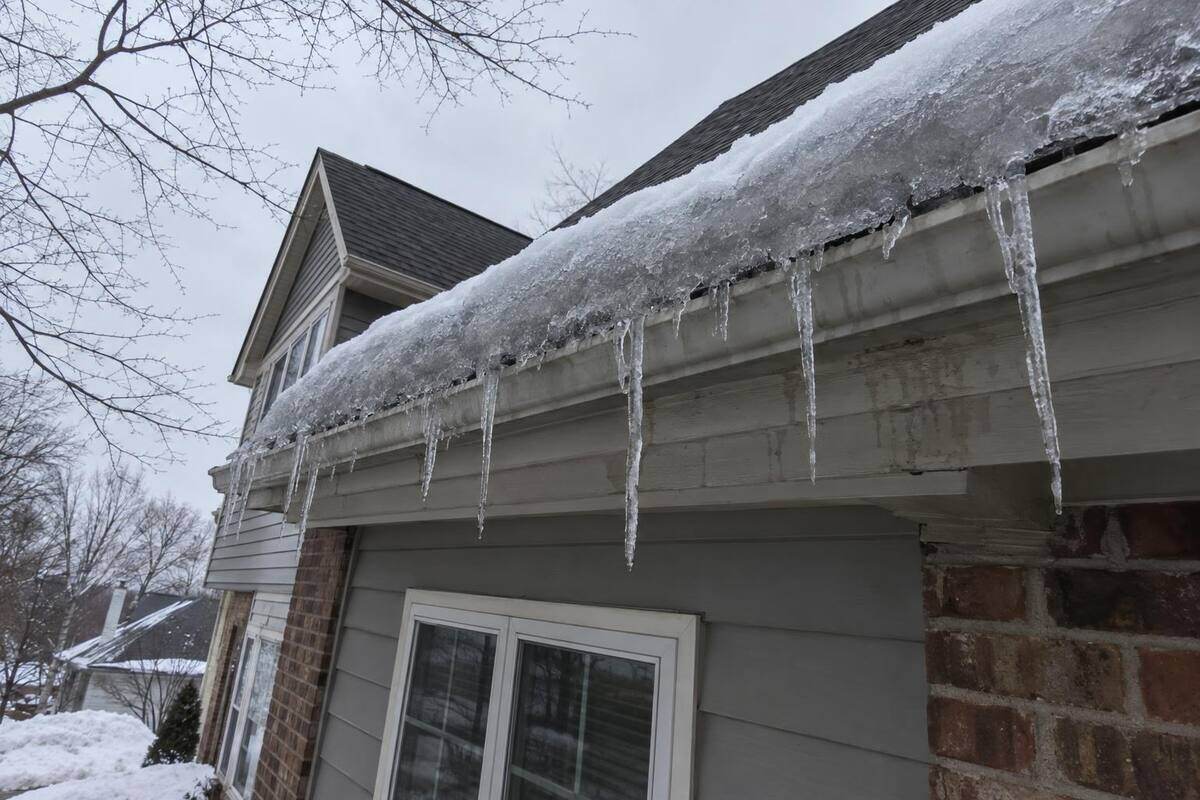
The mechanism is described plainly by Michigan’s Department of Insurance and Financial Services, which tells homeowners to keep gutters clean of leaves and debris “to prevent ice damming, which occurs when melting ice spreads under roof shingles.” That is the whole failure in one sentence. Snow melts at the warm upper part of the roof, runs down to the cold eave, refreezes into a ridge, and the water backing up behind that ridge no longer has anywhere to go but sideways and under.
A West Michigan roofer quoted by WWMT put the consequence in the terms a homeowner cares about: service calls have risen with temperature-swing winters, and the water intrusion damage “can get into the thousands of dollars pretty quickly.” No local contractor publishes a price for the work, and this site does not invent one — but the comparison being made is between a service call and a repair bill in that range.
It is worth being clear about what this page is not saying. Roof collapse from snow load is not the ordinary West Michigan failure mode and it is not the reason to pick up the phone. Look for the signs of water instead: icicles thickening along one eave, a wet stain appearing at the top of an interior wall, a damp line on a basement wall under a valley, or a section of eave that stays iced while the rest of the roof clears.
Michigan’s code requires footings to extend not less than 42 inches below finished grade, statewide, a frost-depth rule that applies uniformly unless a local building official modifies it for site conditions. Once a builder is digging to 42 inches anyway, the basement is nearly free — which is why full basements are effectively universal across this metro rather than the exception they are in warmer states. Plenty of homes here take it further and open the downhill wall as a walkout, because the ground rolls.
That matters on this page because it sets the length of the path water can travel. An ice dam is a roof problem for about the first hour. After that it is a wall-cavity problem, and in a house with a finished lower level it can become a basement problem several days later, a long way from the eave that caused it. The most expensive ice dam is the one nobody found until the drywall showed it.
Michigan’s Residential Code assigns a ground snow load county by county and, within a county, jurisdiction by jurisdiction. The split across this metro is the building code agreeing with the climatology: the county nearer the lake carries the heavier design load.
| Where | Ground snow load |
|---|---|
| Most of Ottawa County | 50 psf |
| Georgetown, Jamestown, Tallmadge and Zeeland townships (Ottawa) | 35 psf |
| Coopersville, and Allendale, Blendon, Chester, Polkton and Wright townships (Ottawa) | 40 psf |
| Most of Kent County | 35 psf |
| Cedar Springs, and Casnovia, Kent City, Sand Lake, Sparta, Nelson, Solon and Tyrone (Kent) | 40 psf |
Two things follow. First, a house in Hudsonville or Jenison was designed against a different number from a house of the same age in Cascade, and the same storm is a different load on each. Second — and this is the part that gets misused — ground snow load is an engineering input, not a homeowner’s gauge. It describes what the structure was designed around, converted by the code into a roof load. It is not a depth you can measure from the driveway, and nobody should be talking you into a roof clearing by reading a psf figure back to you.
The same state agency states that standard homeowners policies typically cover “ice dams, wind damage, leaky roofs, and a building collapse caused by the weight of ice or snow.” For a homeowner staring at a stain on a ceiling, that is a genuinely useful sentence, and it is from the regulator rather than from a contractor selling the repair.
Three caveats belong with it, and they are the reason this page stops where it does:
Nothing on this page is insurance advice or legal advice, and arranging a contractor through this site has no bearing on coverage. Call your carrier.
A roof rake worked from the ground along the lower few feet of the roof takes away the snow that feeds the dam, without anyone standing on an iced slope. On a single-story ranch or a walkable eave that is often the whole job.
Low-pressure steam is the method that takes an ice ridge apart without taking shingles with it. Chipping at a dam with a hammer or an axe, and dumping rock salt in a nylon along the eave, are the two most common ways a homeowner turns a water problem into a roofing problem.
This is the preventive step the state agency actually names. A gutter packed with last autumn’s leaves holds water at exactly the spot where the refreeze starts.
Not roof repair, not insulation or ventilation work, and not a claim adjustment. If the underlying cause is heat escaping into the attic, the durable fix is a roofing or insulation contractor in the summer, not a plow operator in February.
One more piece of timing. A January like the one in the winter of 2025–26 — about 39 inches in a single month, the seventh-snowiest January at this airport since 1950, with a low of −19 °F on January 24, 2026 — puts a deep, well-frozen load on every eave in the metro. The dam does not form at 19 below. It forms on the day it warms up.
Describe what you can see — which eave, how thick, whether anything has appeared on a ceiling or a wall inside — and roughly how tall the house is. That is enough to match you with someone who does this work.
Call (616) 552-4542 Get a Quote Grand Rapids