The driveway is a convenience. The public walk in front of the house is an obligation with a deadline attached, and the deadline is set by whichever government you happen to live under — twelve hours in one township on the Ottawa side, twenty-four in the city, and no deadline published at all in several places between them.
Shoveling, snow blowing and walkway ice control are performed by independent operators carrying their own insurance. This site introduces you to one and does no clearing of its own.
These are the deadlines and thresholds each government publishes for itself. Where a column is blank, that town has not published a figure — which is not the same as having no ordinance, and is a reason to call the clerk rather than assume.
| Where | What is published |
|---|---|
| City of Grand Rapids | 24 hours after a snow event ends, on the adjacent property owner. A complaint brings written notice and another 48 hours; after that the city sends a contractor and bills the owner, and an unpaid balance can move onto the property tax bill. |
| Grand Haven Charter Township | 12 hours from the end of any significant snowfall, under Ordinance 580 — the shortest deadline published anywhere in this metro. Municipal civil infraction, fine not less than $50 plus costs, $250 or more for a repeat inside six months and $500 or more after that. |
| Kentwood | The owner clears once accumulation reaches 2 inches or more. The city’s contracted sidewalk plow covers designated segments once per event only, so a long storm or a second band is the owner’s problem. |
| Wyoming | The city sidewalk plow engages after 2 inches or more of new snow and clears to hard-pack. Owners stay responsible and must keep walks free of obstructions. |
| Hudsonville | The city plows walks as a courtesy, starting around 4 a.m. on major routes — but its own guidance says that under city ordinance it remains your responsibility to shovel the walk in front of your property, because in a heavy event the plows may take several days to reach every one. |
| Every township | No public plow, at any depth, at any point in the winter. See below. |
The ordinance detail town by town, including the places that publish nothing.
In Ada, Cascade, Georgetown, Plainfield, Byron, Caledonia or Allendale, the roads are not the township’s work — they belong to a county road commission. And the Kent County Road Commission states it without qualification: it does not clear sidewalks or non-motorized paths. Its job is the roadway, in a fixed order that runs state highways, then county primary routes, then local paved roads, then gravel roads and subdivision streets, with a target of one full pass on all county roads within 36 hours of a storm ending. The Ottawa County side runs the same model, with dead ends and cul-de-sacs last.
That has a practical consequence worth being blunt about. A township household that expects a public crew on the walk after a heavy band is waiting for something that does not exist, and the non-motorized paths that make these townships pleasant in July are, in January, entirely a private matter. Allendale Charter Township goes a step further in the other direction: its ordinance does not set a clearing deadline at all, but it does prohibit depositing snow, ice or slush from private property onto a non-motorized pathway without written township permission, with a penalty of up to $500 or up to 90 days behind it.
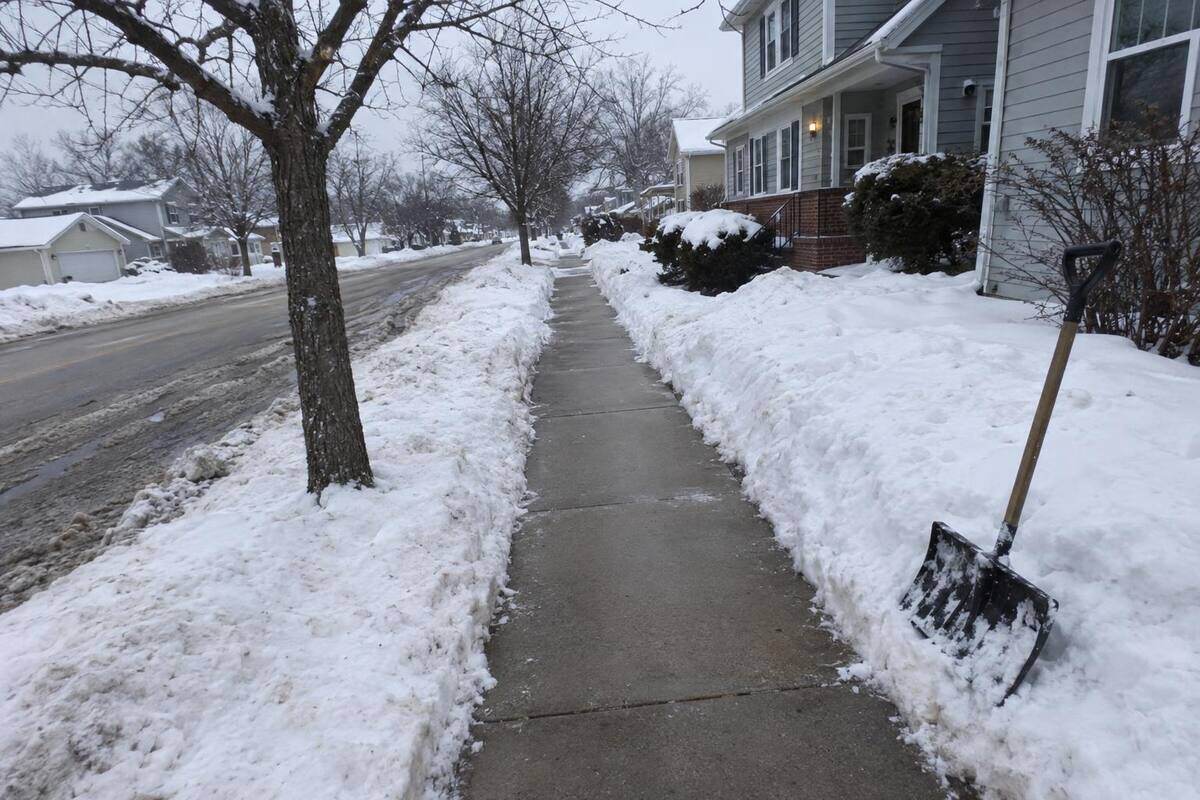
The City of Grand Rapids sends a contracted plow over more than 200 of its 922 sidewalk miles once an event puts down 3 inches or more, clearing down to about a half-inch layer. Read the numbers honestly and the program covers roughly a fifth of the network, for events above three inches only — residents remain responsible for the rest, and for every smaller storm. Kentwood’s and Wyoming’s programs are narrower still, one designated pass rather than a finished walk.
During extreme cold the city has also relaxed enforcement to a good-faith standard, closing complaints where a walk is reasonably passable and dispatching a contractor only where no attempt was made at all. That is discretion in a hard winter, not a change in the rule — and none of the three programs moves the obligation off the owner.
For years a property owner in Michigan had a powerful answer to a fall on an obvious sheet of ice: under the old open-and-obvious doctrine, an obvious hazard could defeat the owner’s duty outright, and a case could be dismissed before a jury ever heard it.
In Kandil-Elsayed v. F & E Oil, Inc., decided July 28, 2023, the Michigan Supreme Court overruled that framework. The case itself was a snow-and-ice case — a fall on an unshoveled, snow-covered walkway. A land possessor still owes invitees a duty to exercise reasonable care against an unreasonable risk of harm from a dangerous condition; whether the hazard was open and obvious now folds into breach and comparative fault, which are jury questions. The court also set aside the old special-aspects exception in favor of whether the possessor should have anticipated the harm despite the obviousness.
Set that beside a 24-hour clock in the city and a 12-hour clock in Grand Haven Charter Township and the case for clearing promptly stops being about tidiness. This page describes what the law says; it is not legal advice, and arranging a contractor through this site does not discharge or create any duty you have as an owner.
On a seasonal agreement, sidewalks are usually written as part of the same visit as the driveway rather than as a separate call, and that is the version worth buying — a walk cleared six hours after the drive is a walk that spent six hours inside somebody’s deadline.
Tell us the town, the frontage — one side or a corner — and whether there are steps. Deadlines differ enough here that the town alone changes the answer.
Call (616) 552-4542 Get a Seasonal Quote Grand Rapids