A flat price from mid-November to the first of April, an operator on the drive after every event over two inches, and night storms finished before the school run. This is what a West Michigan snow contract looks like when it is written normally.
The plowing is done by an independent operator under its own company name and its own insurance. This site introduces you to that operator and performs none of the work.
Search what snow removal costs in this metro and the first page belongs to national estimator sites that have never quoted a driveway in Kent or Ottawa. One local contractor publishes its full grid, and because it is the only one, it is the benchmark worth measuring a quote against rather than an invented range.
Roughly $425 to $605 for the season, covering a standard driveway up to 100 feet. The spread inside that band is width and shape — a single-lane drive at the bottom, a triple-lane or a double-car Y at the top. It is priced by configuration, not by the square foot.
November 15 through April 1. A two-inch trigger, automatic rather than on request. A night storm holding two inches at midnight is finished by 8 a.m. Daytime plowing generally does not start under four inches. Stake markers go in around mid-October and come out in the first week of April.
That sheet belongs to an operator with an explicitly bounded route through the city core and southern Kent County, and it says outright that some areas fill quickly. Treat the band as a floor for the metro rather than a ceiling: a long graded approach in Ada or Cascade, or an address on the Ottawa side sitting under the heavier lake bands, reasonably prices above it and nobody publishes those figures at all. The full arithmetic is on the pricing page.
The most consequential line on that rate sheet is not a dollar figure. Standard plans cover plowing until the 77-inch seasonal snowfall average is met, after which a per-plow charge applies unless an unlimited add-on is bought separately.
Now put that beside the federal normal. The 1991–2020 climate normal for Gerald R. Ford International is 77.6 inches a season. The contract cap and the thirty-year average are the same number to within half an inch. That is not a trick — it is a rational way to price a season. But it means a flat fee is a bet on an ordinary winter, and in a long one the arithmetic changes over the last six weeks.
So the question is not only what the season costs. It is what happens after the cap, what the per-plow rate is beyond it, and what unlimited coverage costs in writing. The seasonal-versus-per-visit page runs it both ways.
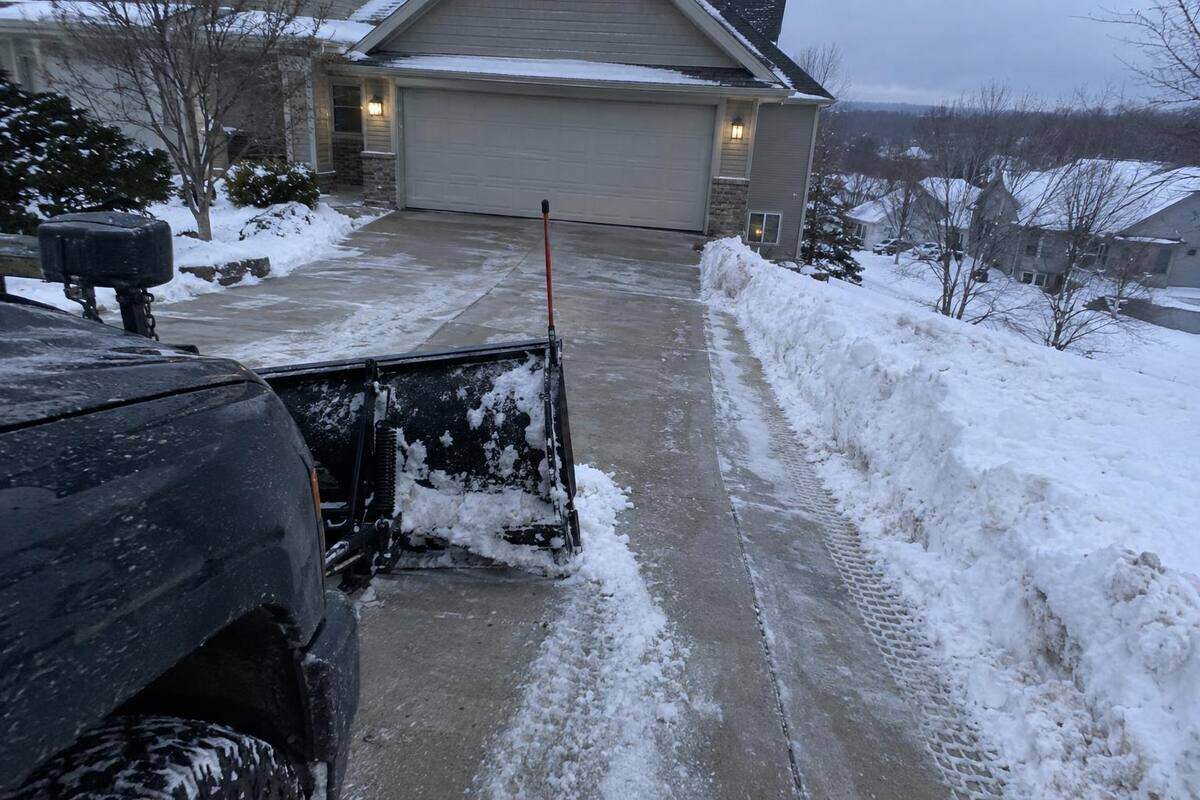
Yours. The Kent County Road Commission puts it in its own words: as a “necessary evil” of winter maintenance operations, snow will be deposited onto driveways during snow removal. Its practical advice is to pile your own snow on the right-hand side of the driveway as you face the road, so the next pass down the street does not put it straight back across the end.
And the state law that fines a homeowner or a contractor for pushing snow onto a roadway does not reach the truck that berms you. Michigan’s statute on obstructing a driver’s safety vision with snow defines “person” so that it excludes the state, a political subdivision and their employees acting within their duties. The rule runs one way. What the statute says, and the $100 civil infraction behind it.
The term to settle, then, is whether a return pass after the public plow is inside the season price or billed on its own. In a township the timing is different again: the road commission targets one full pass on county roads within 36 hours of a storm ending, works a fixed priority order with subdivision streets and gravel roads at the back, and declines off-schedule requests except for police and fire. City or township, and how long you wait.
Town, approximate length, paved or gravel, flat or downhill to the garage, and whether the walk goes with it. Four details and the answer comes back as a number.
Call (616) 552-4542 Get a Seasonal Quote Grand Rapids