An association drive looks like a public street and is treated like one by everybody who uses it. It is nothing of the kind. Every foot of pavement inside the boundary, every shared walk, every mailbox cluster and visitor space is the association’s to clear. The board’s real work is deciding where its duty stops, what the record has to show, and how to budget a winter nobody has seen yet.
Association contracts are signed with independent operators, not with this site. The crew that shows up works for its own company, insures itself and bills the association directly. All that happens here is a connection between a board and operators already running that area.
Whichever agency handles the road outside stops at the road. In a township that agency is a county road commission, and the Kent County Road Commission is explicit about its limits: one pass on county roads targeted within 36 hours of a storm’s end, a fixed priority order leaving subdivision streets and gravel until last, no off-schedule requests except from police and fire, and in its own words, “KCRC does not clear sidewalks or non-motorized paths.” The Ottawa County Road Commission works the same way — roughly 50 callouts and twenty to twenty-five thousand tons of salt a season, cul-de-sacs and dead ends last.
A community on a platted county road gets that road’s pass and nothing further. A community on private drives, as most condominium developments here are, never has a public plow scheduled on any part of it. That is what separates an association budget from a homeowner’s: the association is buying roadway service, priced by width and length rather than by unit count. Which agency handles the road at the entrance.
Most complaints a board fields in February are boundary questions, not quality questions. Three lines deserve settling in writing before the season, because the documents rarely settle them cleanly:
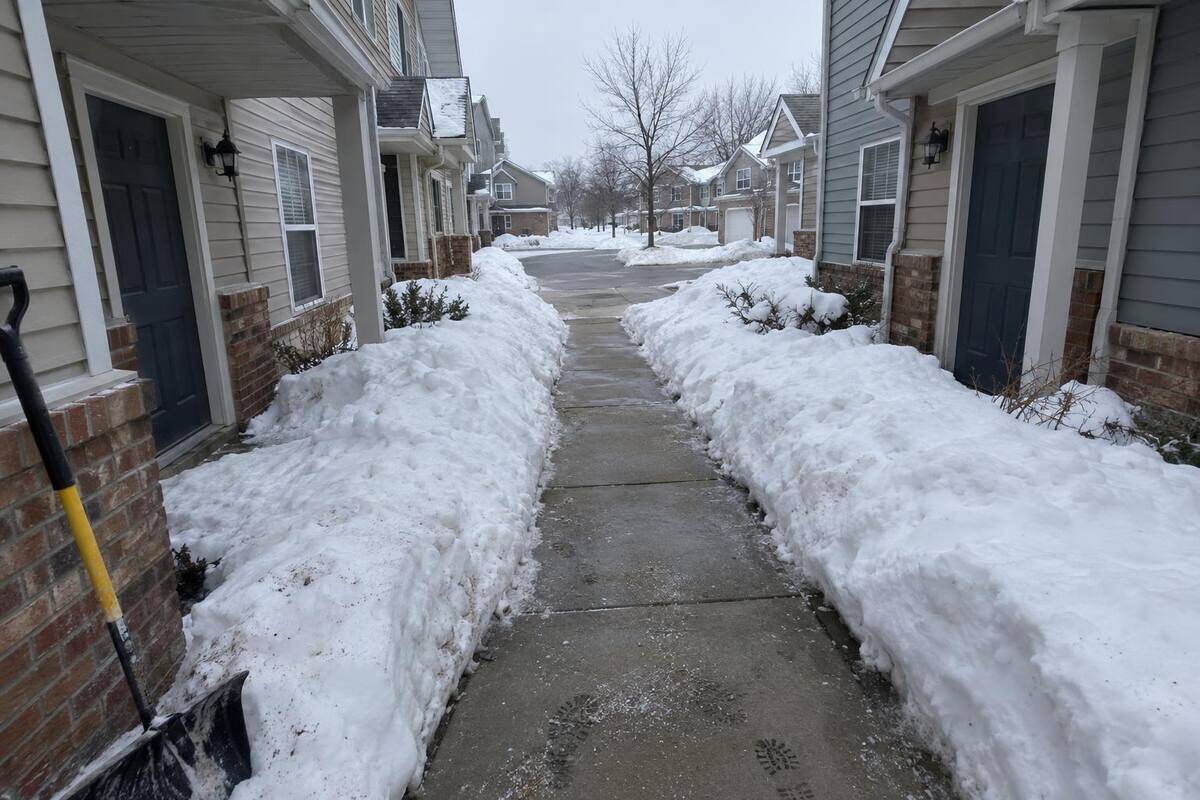
A board sets an assessment in spring and lives with it all winter. The recent record shows how wide that gap opens:
| Season | What it did | Total |
|---|---|---|
| 1991–2020 normal | The figure most budgets are built on | 77.6″ |
| 2024–25 | Finished well under the normal | 63.7″ |
| 2025–26 | Roughly 39″ in January alone, 7th-snowiest since 1950 | ~75″ |
| Muskegon average | Up the lakeshore, same thirty years | 87.2″ |
Eleven inches separate two consecutive seasons at one gauge, and a single month accounted for more than half of the heavier one. A per-event agreement would have produced two very different sets of invoices; a flat seasonal agreement produces one number and moves the weather risk to the operator, who prices it in. Neither is wrong; not knowing which one the association signed is.
Read the cap. Seasonal agreements here commonly cover events up to a stated snowfall total and bill per visit beyond it — the clause that turns a fixed line item variable in a January like 2026’s. Ask what the cap is, then what the overage mechanism is.
A board buys on behalf of people who each judge the result from their own front step, which makes specificity a governance tool rather than a procurement detail.
On July 28, 2023 the Michigan Supreme Court decided Kandil-Elsayed v. F & E Oil, Inc. and overruled Lugo v. Ameritech Corp. A land possessor still owes invitees “a duty to exercise reasonable care to protect [them] from an unreasonable risk of harm caused by a dangerous condition” — and whether a hazard was open and obvious no longer ends a case at the threshold. It belongs to breach and comparative fault, both jury questions, with the “special aspects” exception discarded and summary judgment reversed. The facts were a fall on an unshoveled, snow-covered walkway.
For an association that means the walk nobody owns individually is the walk most in need of a paper trail. Require every visit to record time on site, time off, depth measured, material used and quantity applied, in a form the board can still retrieve two seasons later. A contractor keeping no such record leaves the board with nothing to show about a walk a dozen people use and no one shoveled.
A description of what the Court held — not legal advice, and not an evaluation of any association’s exposure. The association’s own counsel is the right source on how it bears on the documents.
One more item for the same folder. Michigan Residential Code Table R301.2(5) puts ground snow load at 50 psf across most of Ottawa County and 35 psf across most of Kent, with pockets either way — a designer’s input, not a gauge a board holds up against the snow on a clubhouse roof. The Michigan Department of Insurance and Financial Services advises keeping gutters clear “to prevent ice damming, which occurs when melting ice spreads under roof shingles.” Roof snow and ice dams.
Unit count, length and width of drive lanes, linear feet of shared walk, whether the drives are private or platted, the clearing sequence the board wants, and where snow is allowed to sit. That list produces proposals a board can lay side by side at a meeting.
Call (616) 552-4542 Request Bids Grand Rapids