Salt is the one part of a winter contract that has a hard physical limit, and West Michigan spends part of most winters on the wrong side of it. Knowing where that line sits changes what you buy, when you ask for it, and what you put on your own concrete.
Spreading is done by independent operators with their own material, equipment and insurance. This site arranges the introduction and applies nothing itself.
Rock salt works by dissolving into the thin film of water on a surface and dropping its freezing point. That only happens while there is liquid water to dissolve into, and below roughly 15 °F the reaction slows to the point of being useless. This is not a marketing claim; Michigan cities have rationed their own salt during extreme cold on precisely that reasoning, because spreading it simply does not do anything.
This metro gets there. The winter of 2025–26 recorded a low of −19 °F on January 24, 2026, in a January that delivered about 39 inches of snow. On a morning like that a driveway does not have a salt problem, it has a traction problem, and the answer is sand — which does not melt anything and does not care how cold it is.
So a well-written ice-control arrangement says two things: what gets applied in normal conditions, and what happens on the mornings when the normal material is inert. An operator who only has one answer is going to spread it anyway.
Municipal operations are not a rule for private contractors, but they are the most informed local opinion available on how salt behaves on West Michigan pavement — and both of these are published.
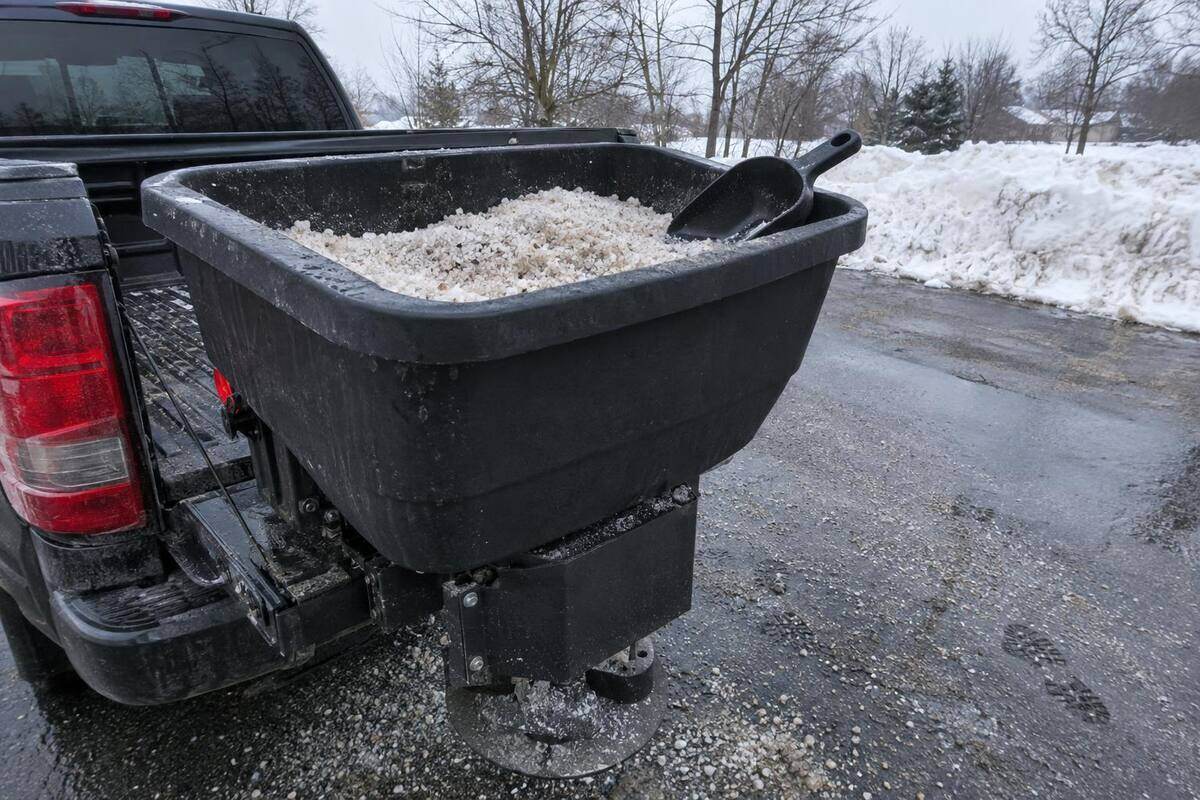
The city applies selectively — first-attention streets, bridges, hills and curves — runs side wings on plow trucks to widen the coverage of each pass, and pre-wets the salt, which it says cuts usage by as much as 30 percent. It has also piloted road-temperature sensors and GPS application tracking. Wetting the material on the way out of the spreader is the single largest efficiency available in this trade.
In the city’s own words, “salt is not used on sidewalks because it can damage/spall the sidewalk, is harmful to the environment.” Where it does need melting at school crossings, it uses a concrete-safe calcium chloride product instead. A city that regulates snow contractors by license has decided its own concrete is worth protecting.
Read together, those two are the argument for treating salt as a targeted material rather than a blanket one: apply it where traction actually matters, in less quantity, wetted, and not on a surface it will damage.
The reason East Grand Rapids draws a line between its streets and its sidewalks is that the two surfaces are different materials with different exposure. Repeated salting on concrete works at the paste holding the aggregate together, and spalling — the surface flaking away in patches — is what it looks like a few winters later. An asphalt drive is less vulnerable to that particular failure, which is part of why asphalt is the more common paved surface across this region: it flexes through the freeze-thaw cycles that crack concrete.
That produces a practical division on most properties here:
What this page will not do is publish working-temperature thresholds for calcium chloride or magnesium chloride blends. Those numbers circulate widely and none of them held up to sourcing for this market, so they are not here. The 15 °F figure for rock salt is the one that is citable, and it is enough to plan around.
Ice control is worth more applied ahead of an event than behind it, because the job is preventing a bond between ice and pavement rather than breaking one that has already formed. The published local rate sheet in this market plows automatically at a two-inch trigger, finishing overnight storms by 8 a.m., which gives a natural window: material goes down after the blade, on a surface that is already cleared, before the morning refreeze.
The awkward case in West Michigan is the long-duration lake-effect band rather than the single storm. A band that keeps producing for a day and a half means the surface is refreezing behind each pass, and that is a conversation about how many applications a season includes and what an extra one costs — not something to resolve at 5 a.m. on the phone.
One honest note on price. The one local contractor that publishes a full residential rate sheet does not itemize salt in its driveway pricing at all; it is handled separately with no published figure. No local operator publishes a residential ice-control number, and none is invented here. Ask for it as a line item, in writing, with the per-application cost named. What is and is not published in this market.
The walk is the surface where ice control stops being a comfort item. Grand Rapids allows 24 hours from the end of a snow event, and during extreme cold it has closed complaints on a good-faith standard where the walk is reasonably passable — which is to say that on the coldest mornings, when salt is inert, passable is the standard being applied. Grand Haven Charter Township allows 12 hours. Neither ordinance cares which material you chose.
And the legal background changed recently. In Kandil-Elsayed v. F & E Oil, Inc., decided July 28, 2023, the Michigan Supreme Court ended the old rule under which an obvious ice hazard could defeat a property owner’s duty outright; obviousness now goes to breach and comparative fault, which a jury decides. The deadlines, town by town. Nothing here is legal advice, and arranging a contractor does not transfer an owner’s duty.
Say what the surfaces are — asphalt or concrete, drive, walk and steps — and whether anything slopes toward the house. Ask for the per-application figure in writing while you are at it.
Call (616) 552-4542 Get a Seasonal Quote Grand Rapids