Nobody arriving at a clinic on a January morning evaluates the middle of the lot. They evaluate the eight feet between a car door and a building door, the curb ramp, the lip where pavement meets walk, and whether any of it was treated before they got there. A building whose visitors are older, unsteady or already unwell is not buying plowing — it is buying a walkable surface at a stated hour, and proof that somebody produced one.
What is arranged here is a conversation, not a service. The operator you speak with runs an independent company, holds their own coverage and contracts with the building directly; no account is administered from this side.
Until that day a Michigan land possessor facing a slip-and-fall claim could often point to the hazard being open and obvious and end the case before a jury weighed anything. In Kandil-Elsayed v. F & E Oil, Inc., decided on July 28, 2023, the Michigan Supreme Court overruled Lugo v. Ameritech Corp. and dismantled that structure.
What survives is the duty: a possessor owes invitees “a duty to exercise reasonable care to protect [them] from an unreasonable risk of harm caused by a dangerous condition.” What changed is where obviousness gets argued. It now sits inside breach and comparative fault — jury questions, not threshold questions — and the narrow “special aspects” exception the older cases relied on is gone. The Court reversed summary judgment for the defendant. The facts underneath all of it were a fall on an unshoveled, snow-covered walkway.
Read that alongside the visitor profile of a medical building and the conclusion writes itself. A specification here should be built backward from what it would need to show about a Tuesday morning eighteen months ago: when the crew arrived, what they found, what they applied, how much, and when they left. Everything below is downstream of that.
This sets out what the Court decided and stops there. It is not legal advice and makes no claim about any particular building’s exposure, which is a question for a Michigan attorney and the building’s own carrier.
“Plow-clean” is a reasonable standard for a drive lane and an inadequate one for a threshold. The two surfaces need separate language in the same contract, because a blade leaves a quarter inch of packed snow behind and that quarter inch is exactly what refreezes under a cane tip.
Name the surfaces that have to come to bare pavement and the hour by which they do:
Write these as a separate scope line with a separate time, and settle who owns the vestibule mats while you are at it — not snow removal, but part of the same fall. A bid that folds walks into a lot price has priced the least risky part of the property and left the riskiest to goodwill.
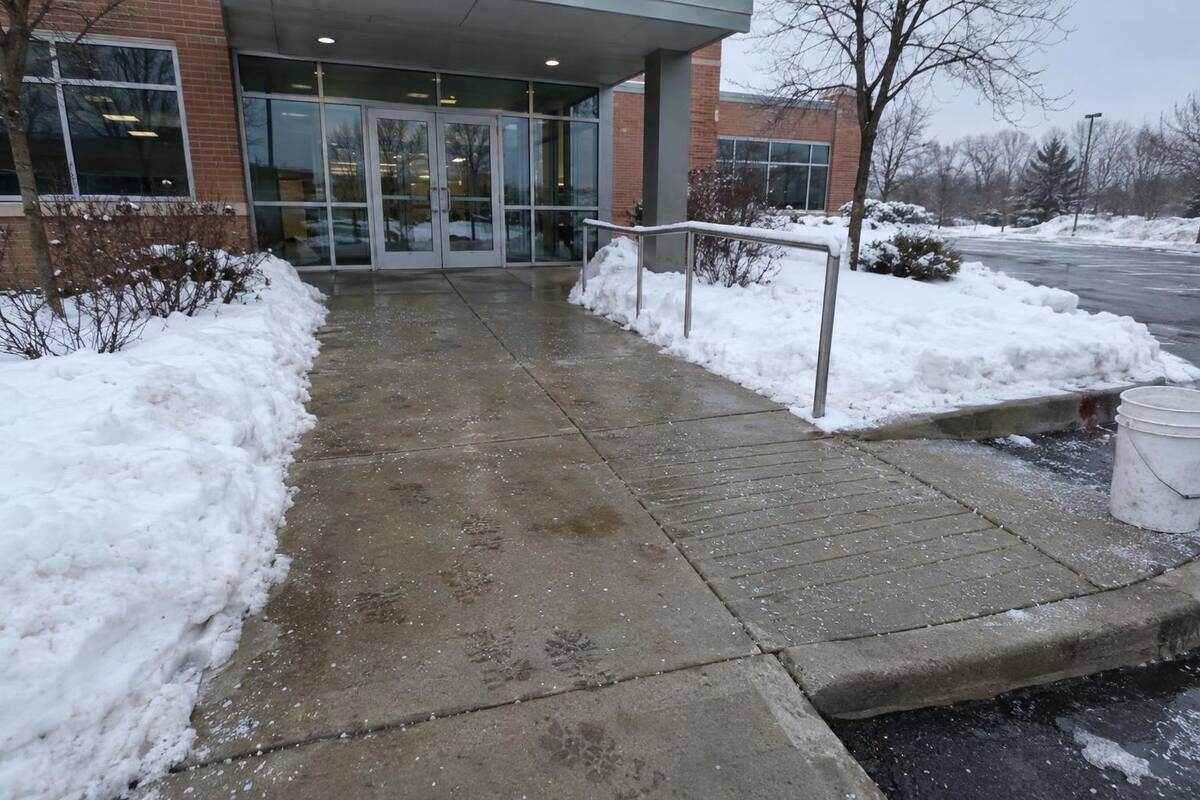
Anti-icing before an event is the one line on a medical property that is cheaper than what it prevents. A pre-treated walk keeps the first accumulation from bonding, so the morning pass removes snow instead of chiseling ice and leaves bare surface rather than polished.
A clinic opening at eight has staff arriving by seven and patients in the lot by half past. The deadline is the earliest arrival, not the posted hour, and it belongs in the agreement as a time of day rather than a response interval.
Entrances and the accessible route, then the drive lane serving them, then general parking, then the perimeter. Without a written order the crew will do what is fastest, which is the lot, because the lot is where the machine already is.
Most events here are not one clean drop. Continuing snow needs return visits at the door while the building is occupied, and “as needed” is not a term anyone can audit afterward.
Over January 12–15, 2024, northwest Grand Rapids recorded 27.5 inches while East Grand Rapids recorded 21.9 and Ada 18.4. Name the gauge that starts the clock; no count of two-inch days is published for the airport, so no bid can promise a number of events.
Rock salt loses effectiveness below roughly 15 °F. This metro reached 19 degrees below zero on January 24, 2026. Somewhere between those two figures a contract that says only “salt as needed” stops describing anything useful, and the crew is left improvising on the coldest morning of the year at the property with the most vulnerable visitors.
So write it down: what goes down above the threshold, what goes down below it, who decides. Below the working range the honest answer is traction material for grip rather than a heavier salt application for melting, especially on walks, ramps and stair treads. Ask a bidder what they do at five degrees; an operator with a real answer gives it in a sentence.
Grand Rapids shows the other half of good practice on the public side: it pre-wets its salt, cutting usage “by as much as 30 percent,” and applies material selectively rather than uniformly — first-attention streets, bridges, hills and curves. On a building site the equivalent is treating entrances, ramps, the slope in the drive lane and the shaded north walk on a schedule, and leaving the back lot alone. What to specify for ice control.
Coverage, read rather than described. Ask for the certificate and for additional-insured status in the building’s name. No contractor in this market advertises a limit, so any figure presented as the regional standard is somebody’s invention; the building’s own carrier or broker is the party to say what it wants to see.
Workers’ compensation. Michigan is not a monopolistic workers’ compensation state, and coverage is required of a private employer once it has one employee working 35 or more hours a week for 13 or more weeks in the preceding year, or three employees at one time counting part-time staff. A single-truck operator may sit under that line legitimately; a crew clearing walks by hand at a medical entrance generally will not.
Licensing, and what it is not. Michigan licenses no snow-removal trade; the Occupational Code covers builders, maintenance-and-alteration contractors and the design professions, and snow work appears nowhere in it. “Fully licensed” on a proposal therefore describes nothing at state level. The one local exception is East Grand Rapids, which requires a City Clerk license under § 7.90 before a contractor may advertise, solicit, contract or operate there, August 1 to May 1, with the roster published. What that license covers.
The address, the hour the earliest staff member arrives, linear feet of walk and number of entrances, whether there are exterior stairs or ramps, and whether pre-treatment is wanted as a standing service. Proposals built on that can be read against each other line by line.
Call (616) 552-4542 Request Bids Grand Rapids