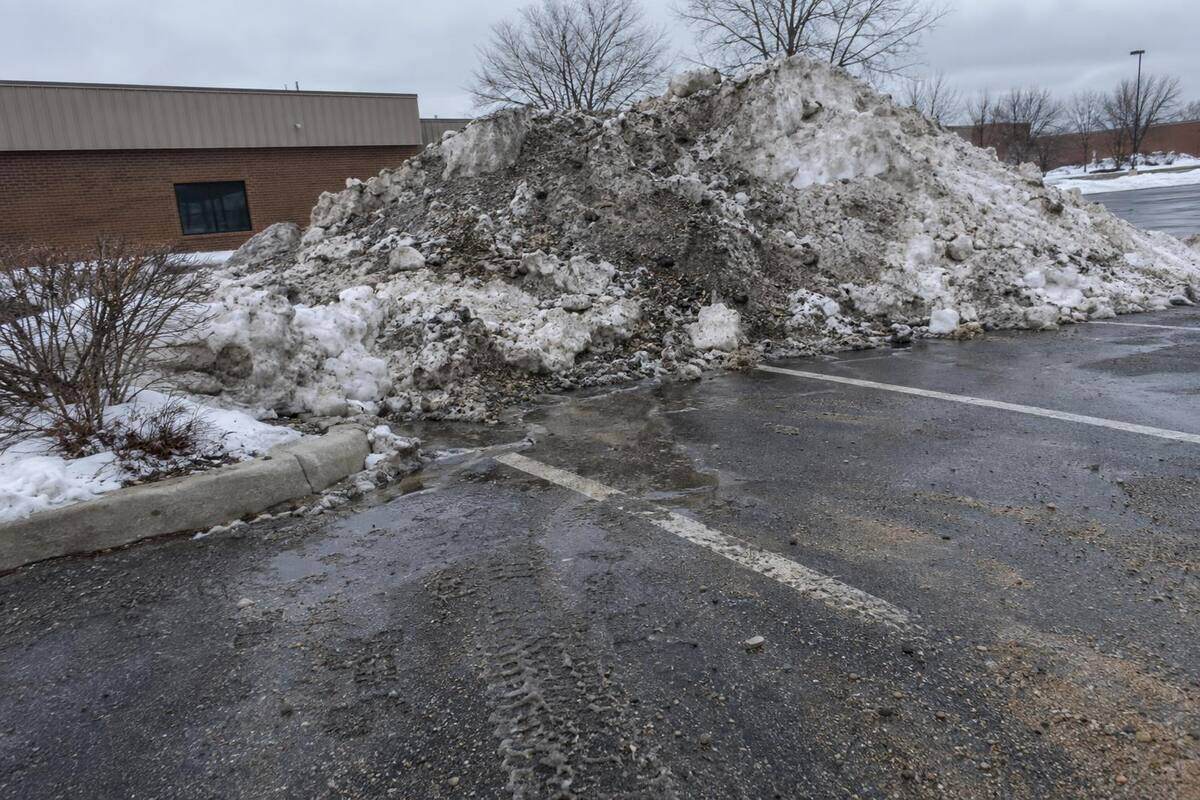
Plowing a lot does not take snow off the property. It moves the snow to a corner somebody chose in October, and most of the winter turns on whether that corner was big enough and whether anyone wrote down where it was. Acreage is what every bid asks for first; storage, sight lines and the hour the doors open are what decide the season.
Lot work is performed by independent snow contractors. They carry their own insurance, run their own equipment and sign directly with you. What happens here is the introduction, nothing past it.
A normal winter drops 77.6 inches, about 8.1 of those days delivering three inches or more at once, and little of it leaves on schedule. Each pass stacks onto the last, so a pile that looked generous over Thanksgiving is eating revenue stalls by Presidents’ Day. January 2026 made the point hard: roughly 39 inches in one month, the seventh-snowiest January here since 1950, inside a season near 75 inches. Two winters earlier the total was 63.7 — a site that absorbs a 63-inch year without hauling may not absorb a 75-inch one.
Ice control belongs on its own line, priced per application with the material named, because a plow line and a salt line answer different questions after the fact. What to specify for material and temperature.
“Prompt service” is unenforceable. A window is a start time and a finish time attached to a named part of the property, and a lot needs three of them.
An empty site goes curb to curb — the only pass where a blade reaches the stall lines. State the hours the lot is guaranteed empty; one row of parked cars leaves a patchwork that freezes into ruts.
Entrances, accessible route, curb ramps and the first rank of stalls, done before the earliest employee arrives rather than the first customer. Name that hour; it is rarely the posted opening time.
A storm running all day needs somebody on site while people move, working around occupied stalls. Most bids leave it vague; most owners assume it is included.
Two inches at the airport is not two inches at your entrance. Over January 12–15, 2024, Lowell recorded 31.6 inches and Ada 18.4 — one storm, one metro. Say which gauge, on whose property, starts the clock.
No count of two-inch days is published for Gerald R. Ford International — only 50.9 days at a tenth of an inch, 23.5 at an inch, 8.1 at three. A bid promising a number of two-inch events is guessing.
Outside city limits the roadway belongs to a road commission. The Kent County Road Commission targets one pass on county roads within 36 hours of a storm ending, puts subdivision streets and gravel last in a fixed priority order, takes no off-schedule requests except from police and fire, and states plainly that it does not clear sidewalks or non-motorized paths. The Ottawa County Road Commission runs the same model — roughly 50 callouts and twenty to twenty-five thousand tons of salt a season, cul-de-sacs and dead ends last. None of it crosses the property line: aprons, drive lanes, loading areas and every foot of walk are private work from the first flake, and a site on a private drive gets no public crew at all.
Traffic in the other direction is regulated, so put the disposal route in the agreement. MCL 257.677a makes depositing snow on a roadway a civil infraction of not more than $100, and Allendale Township § 389-9 bars pushing it onto a non-motorized pathway without written permission, § 389-16 penalties reaching $500 and 90 days. A crew that clears your lot across public surface creates an exposure that lands on the property, not on the truck. Which agency handles the road at your address.
In Kandil-Elsayed v. F & E Oil, Inc., decided July 28, 2023, the Michigan Supreme Court overruled Lugo v. Ameritech Corp. A possessor still owes invitees “a duty to exercise reasonable care to protect [them] from an unreasonable risk of harm caused by a dangerous condition” — but whether a hazard was open and obvious now sits inside breach and comparative fault, which are jury questions. The Court discarded the “special aspects” exception and reversed summary judgment; the facts were a fall on an unshoveled, snow-covered walkway. That is what makes the service record worth negotiating for:
| Field | What it establishes |
|---|---|
| Time on site | Ties the response to the trigger and the window. |
| Time off site | Duration — a full pass against a drive-through. |
| Depth on arrival | Anchors the event to your property, not the airport. |
| Material applied | Shows the temperature policy was followed, not improvised. |
| Quantity applied | Turns “salt was applied” into something checkable. |
This states what the Court held, nothing more — not legal advice, not an assessment of any property’s exposure. One more line for the checklist: Michigan licenses no snow-removal trade, so “licensed” carries little weight in a bid here. The lone local exception is the City Clerk license East Grand Rapids requires under § 7.90, August 1 to May 1, roster published.
Site address, approximate lot and walk square footage, the hour the property has to be open, where snow can be stacked, and whether the drive meets a city street or a county road. Enough for bids that compare line against line.
Call (616) 552-4542 Request Bids Grand Rapids